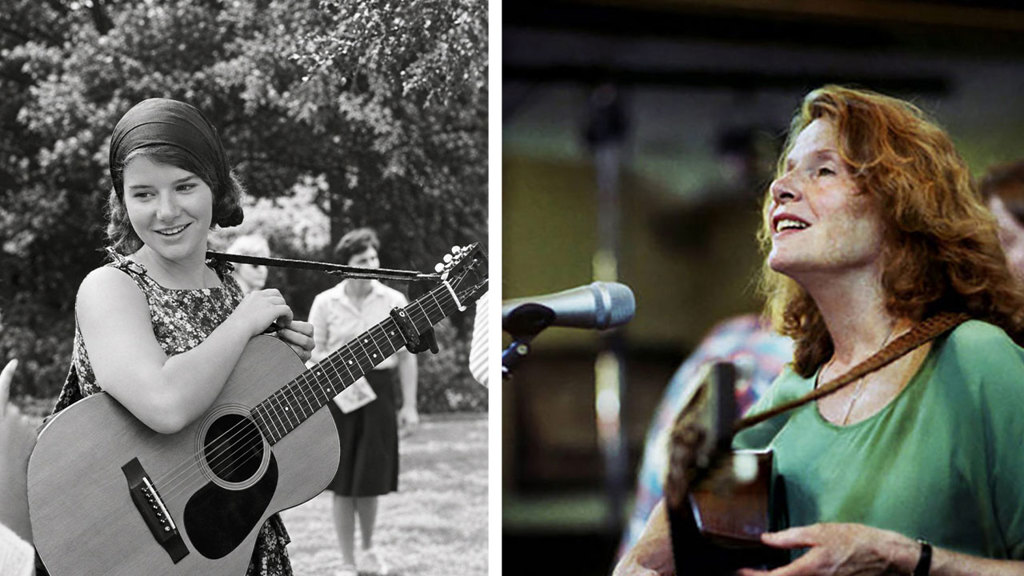
Bonnie Dobson and the morning after humanity disappeared
“Bonnie Dobson, 21, sounds nearer to Joan Baez than any of the other new folk-girls, (...): for Joan’s tragic, gypsy quality, Bonnie substitutes a fresh, willowy charm that never deserts her in even the darkest...
“Bonnie Dobson, 21, sounds nearer to Joan Baez than any of the other new folk-girls, (...): for Joan’s tragic, gypsy quality, Bonnie substitutes a fresh, willowy charm that never deserts her in even the darkest laments.” Time Magazine, June 1, 1962 Bonnie talking to Diane Goldstein at Philadelphia Folk Festival, . Bonnie onstage at the Royal Hall London, 2013, photograph Laurie When I started working as a scientist in the Department of Immunization, Vaccines, and Biologicals at the World Health Organization’s headquarters in Geneva in 2001, one of my first tasks was to update the guidebook on the international packaging and transport of vaccines. When I spoke to my supervisor Julie Milstien about identifying the most suitable consultant for this task, she suggested I contact Andrew Garnett.
I met Andrew in London. Meeting Andrew not only led to the preparation of various guidebooks on vaccine logistics, but also opened the door to many new visions and projects. From that day on, we became close friends and worked together on countless projects.
We jointly launched the Effective Vaccine Store Management initiative and the Performance, Quality, and Safety project. Andrew was our first choice to author cold chain management guidelines. He was an impeccable editor in many of the technical series we worked on together.
As an architect, Andrew was a master of mind maps. His ability to turn any complex concept into a clear mind map structure fascinated me. Andrew passed away on February 22, 2015.
I always deeply admired his elegance, refined artistic taste, scientific rigor, and passion for life. I still miss him very much. My friendship with Andrew also gave me the opportunity to meet another wonderful person: his wife, Bonnie Dobson.
Canadian-born folk singer Bonnie rose to fame in the 1960s and, although she is best known for her songs I’m Your Woman and Morning Dew, her fame was by no means limited to these. She released her first album, Bonnie Dobson – She’s Like a Swallow, in 1961 and published five more albums until 1972. After her final concert in 1989, she withdrew from the public eye.
But her song Morning Dew journeyed from Bonnie’s folk performances, through the Bob Dylan-influenced Greenwich Village scene, and on to rock music. Bonnie moved to England in 1969. She didn’t return to the stage until 2007, when she performed at the “The Lost Ladies of Folk” concert as part of the Meltdown Festival at London’s Queen Elizabeth Hall.
The following year, on January 18, Bonnie joined us in Paris to sing at the opening of our cartoon exhibition “Le ” in memory of Hrant Dink, together with Ohannes Şaşkal. In 2013, she performed a duet with Robert Plant at the memorial concert A Celebration of Bert Jansch. They performed “Morning Dew,” which Robert Plant described as “a spectacular piece of music” and had previously covered on his 2002 Dreamland album.
Recently, John Einarson’s book “Take Me for a Walk in the Morning Dew: The Life and Times of Bonnie Dobson and the Story of Her Unforgettable Song” was published. I read the book in one sitting. I also got Bonnie’s promise to sign the book for me when I first arrived in London.
The book is interesting not just as Bonnie’s biography, but also as a study examining how a work of art can outlive its creator, change meaning as it travels between cultures, and even become separated from the person who created it. Bonnie wrote “Morning Dew” in 1961, inspired by the Cold War atmosphere and especially by the nuclear apocalypse scenario in the film On the Beach. One night in 1961 in Los Angeles, the conversation with friends turned to the possibility and consequences of nuclear war.
Bonnie says the discussion was scary: “I woke up the next morning and started writing the song.” Bonnie had never written a song before, nor even attempted it. The song imagines two people facing a world where almost everyone has disappeared. The Canadian Songwriters Hall of Fame writes the following for the song: “Morning Dew is a dialogue song between the sole surviving woman and man; she is naively in denial; he is the hopeless voice of doom.
Radiation has turned the morning dew – yesterday’s life-giving water - into an annihilator. (...) Bonnie Dobson’s mournful descending melody effectively portrays the nuclear rainfall and humanity’s downward spiral.” This heartbreaking post-apocalyptic story, inspired by the threat of nuclear annihilation that could befall us at any moment during the Cold War, evolved from an acoustic folk song into a classic hard rock anthem. Nearly a hundred artists have recorded the song, including Grateful Dead and Robert Plant, as well as Rod Stewart, Nazareth, Duane and Gregg Allman, Clannad, Devo, Procol Harum, The National, and pop singer Lulu.
Another artist who performed the song was American singer-songwriter Tim Rose. However, by adding his name as a co-writer, Tim in effect took the song hostage and earned royalties from it for years. Bonnie regained her own song 50 years later.
In 1961, the first album featuring Morning Dew, and the 2014 release “Take Me for a Walk in the Morning Dew” - Bonnie Dobson & Her Boys Led Zeppelin’s legendary frontman Robert Plant also performed Morning Dew on his 2002 Dreamland album. Bonnie and Tim were listed as the song’s authors on the album. In the book, Robert recounts his meeting with Bonnie: “I got a knock on my door, and I opened the door, and a woman was standing there.
She says, ‘My name is Bonnie Dobson. I wrote ‘Morning Dew’. And I went, ‘Oh!
What?’” In the book, Bonnie describes what happened after knocking on Robert’s door: “When Robert recorded my song, he didn’t know about the credit controversy. He just lived a street or two over from me, and after I explained it to him, Robert realised that my credit had been obscured by Tim Rose. So, he wanted to make it right.
He understood that there had been an injustice. Robert came to understand that it was my song. When he introduced me at that Bert Jansch concert, I had invited all my children and my Birkbeck College work colleagues to be there.
They hadn’t ever seen me perform. It was a cracking good night, magical.” On December 8, 2013, Robert Plant invited 73-year-old Bonnie to the stage at London’s Royal Festival Hall with these words: “Back in the 60s, I used to sing a song that was immortalized by Tim Rose and, I guess, the Grateful Dead. Later, in the 90s, I recorded this song.
One day, there was a knock on my door, and this lady stood at my door and said, You’re singing my song. I was unaware that this spectacular piece of music had been written by this great person. Ladies and gentlemen, please welcome...
Bonnie Dobson!” In 1961, Bonnie wrote the song Morning Dew, imagining the end of the world in the wake of a nuclear war. Today, even though we may have forgotten the Cold War years, we can still listen to the song. The song’s emotional language remains relevant today because the underlying fear has not disappeared: the fact that a small number of people possess the power to destroy the world, and that the majority of people will be left to live or die with the consequences of decisions they did not make… With Bonnie Dobson, London, 14 October 2022 With Morning Dew, Bonnie includes us in the world left after the event without ever preaching about nuclear annihilation; she [indirectly] conveys the issue’s political and existential meaning.
Without ever saying that nuclear bombs are bad, that governments are irresponsible, that war can destroy humanity, or that ending the arms race is important, she lets the listener discover what happened. She almost whispers... “Take me for a walk” is a request for companionship.
Even though the world has ended, the fundamental human desire still persists: Don’t leave me alone. And probably for this reason, even after more than sixty years, the event still feels haunting to us. With deepest admiration, always, Bonnie...
Ümit Kartoğlu Bonnie Dobson ve insanlığın ortadan kaybolduğu ertesi sabah