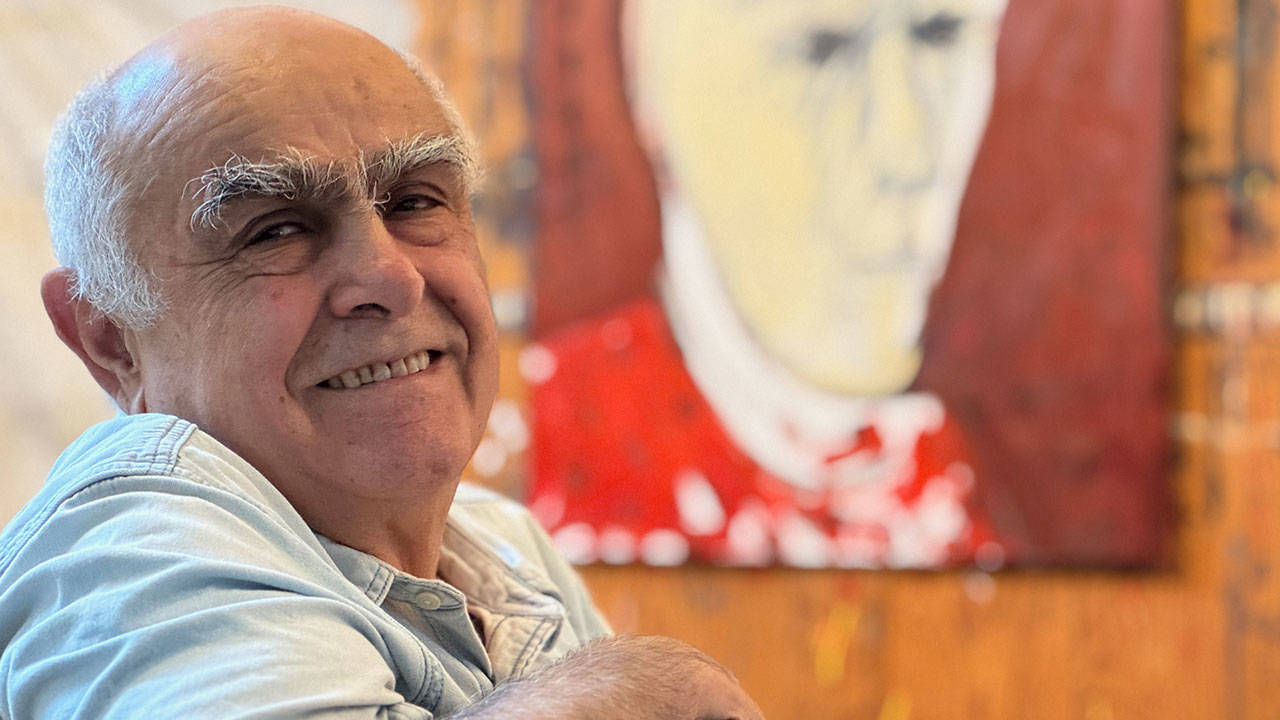
Paris, 1989. July. The streets are overflowing with the excitement of the celebrations marking the 200th anniversary of the French Revolution.
The city is covered with surrealist posters and flags featuring three birds in flight, designed by Jean-Michel Folon for the bicentenary. I, however, am in pursuit of traces of another past. With an address in my hand, I walk through the streets of Paris looking for İsmail Yıldırım’s studio.
It has been nine years since we last saw each other. We embrace with joy. In his small studio, everything is piled on top of everything else; the place is filled with paper, canvases, paint, and brushes.
Scribbled sketches, some finished and others half-done, cover every available surface, even the floor. We talk, but my eyes keep wandering toward the drawings scattered across the floor. I bend down and start collecting the ones I like most.
“I’m taking these,” I tell him. Those paintings now hang on the walls of my home in Geneva. I did not know it then, but the doorway into İsmail’s art was not really the door of a studio.
It was the doorway to a memory. My connection with İsmail went back to a shared period that had begun long before Paris. While working at Güney Kültür Publishing, İsmail had wanted to turn the K-ÖMÜR caricature exhibition that Ohannes Şaşkal and I had organized into a book.
The project never materialized because of the September 12, 1980 coup. Years later, in January 2008, İsmail would once again play an important role in making possible the Le caricature exhibition that Ohannes and I organized in Paris in memory of Hrant Dink. At the opening of the Le caricature exhibition in memory of Hrant Dink: Ümit Kartoğlu, Fazıl Say, İsmail Yıldırım and Ohannes Şaşkal.
Paris, January 18, 2008. (Photo: Nellie K.) LARGE CANVASES IN THE VILLAGE STUDIO This time, I visited İsmail in Saint-Aubin-Château-Neuf, a charming little village about two hours from Paris. We caught up over rice he had prepared with morel mushrooms brought from his village in Türkiye.
The setting had changed, but İsmail’s world had not. When I entered his studio, I felt the same intensity - large canvases leaning against the walls, sculptures, and a powerful relationship with the materials themselves. For İsmail, the studio was not just a place of production, but also a space where he processed the memories and confronted the past.
In İsmail Yıldırım’s studio in Saint-Aubin-Château-Neuf The paintings by İsmail that hang on my walls were relatively small. I asked him what had led him to start working on such large canvases. “You have to call it curiosity,” İsmail says.
“But I’m also someone who worries. Whatever I do, I always ask myself: What is happening? Am I doing something worthwhile?
Those two things have driven me, and I have spent a great deal of time looking at painters.” He tells me that he has studied painters from every possible angle. He talks about Honoré Daumier and Jean-François Millet, pointing out that both worked on relatively small scales. And then there is Paul Klee.
Most of Klee’s paintings are roughly A3 size. They did not have space to work on big canvases. “The small scale for these painters was a matter of circumstances,” İsmail says.
“I wanted to make large paintings. I wanted to make sculpture and engravings. I did all of that by expanding my possibilities.
After we first met in Paris, I separated my home from my studio. I’m a messy worker, you know. Everything spills onto the floor; everything is everywhere.” İsmail says that he began by enlarging his studios.
And it was not only in Paris. He tells me that the main reason he bought the property in the village was to be able to make large sculptures and large paintings. İsmail Yıldırım in his studio in Belleville.
(Photo: Philippe Cibille) MADIMAK: THE MEMORY OF FIRE AND ASH The Sivas Madımak Hotel massacre was also a profound turning point in İsmail’s artistic life. The brutality of what happened became embedded in collective memory not only through the pain of those authors, poets, and artists who were killed, but also through the deep wound it opened in the conscience of society. Rather than depicting this wound directly, İsmail chose a different language.
Fire, ash, charred wood and blackened surfaces became carriers of collective memory in his work. Ash is not simply what remains after destruction; it is the trace of what must not be forgotten. Fire becomes not only a symbol of annihilation, but also of remembrance.
A WOMAN’S RETURN TO LIFE One of the most striking aspects of İsmail’s art is its transformative effect on people. The story of a woman who abandoned thoughts of suicide at the darkest moment of her life after encountering his paintings is a remarkable testimony to the healing power of art. When I asked him, “Even if I like the painting as a work of art, why would I put a painting of pain and wounds on my wall, İsmail?”, he told me about a couple who had bought such paintings.
“I became curious and asked them, ‘Why are you buying my paintings?’ The woman pulled up her sweater. There was a scar at least thirty centimeters long. ‘This,’ she said, ‘is the scar from my last suicide attempt.’” She had tried to shoot herself with a rifle, but had survived.
She told İsmail that after seeing his paintings, she had decided not to take her own life. “Your paintings contain all the pain, all the hardship of the world,” she told him. “But at the same time, your paintings say, ‘Come on, start again.
Get back on your feet.’” As İsmail painted his own wounds, he had somehow touched the wounds of other people and helped her reconnect with life. “I PAINT AS IF I WERE SCRATCHING MY WOUND” Although İsmail paints the sky and the earth, what he is really depicting is war, migration, floods, and a polluted natural world. “Now I’m trying to synthesize all of this in my paintings and sculptures,” he says.
“I make paintings and sculptures somewhat as if I were scratching my wound. In that sense, I have a crack, a fracture in me. Whatever I do, I do it through that.
Whether I draw Konca Kuriş or Palestine, in a way, I am drawing myself.” In this sense, İsmail’s art is not an escape but a confrontation. When he paints, he reopens the wound, trying to understand and give meaning to it. THE VILLAGE, OPEN STUDIOS AND SHARING ART The village where his studio is located is much more than a place to live.
It is a place where art meets people, where sharing and collective production are possible. The Open Studios initiative is an extension of this philosophy. “When I was trying to understand Paris as a city, I realized that young painters were often renting spaces for themselves in poor neighborhoods, without even knowing about one another.
When I came to Belleville, I discovered that there were many painters around us. We first formed an association, and then we began opening our doors to the public every May. It was not directly aimed at selling; it focused on meeting the public, discussing and getting to know one another.
That is why I might say it became perhaps the longest-running Open Studios movement in the world. At the same time, it was a carefully calibrated anarchist left-wing movement.” İsmail also organizes Open Studios events in his village. Children at an Open Studios event in Saint-Aubin-Château-Neuf.
(Photo: Philippe Cibille) PARIS, EXILE AND THE JOURNEY OF AN ARTIST İsmail’s life story cannot be separated from the history of a particular period in Türkiye. Following the 12 March 1971 coup, he was sentenced to five years in prison in the THKO case. The sentence was handed down after an amnesty law had been enacted; as a result, İsmail served the entire term.
His prison journey took him from Mamak to Ulucanlar, Amasya, Merzifon, Konya and Muğla. He met Yılmaz Güney at Ulucanlar Prison. “He knew that I painted and would look at my work.
Yılmaz Abi’s greatest quality was that he never pretended to know about something he didn’t understand. When he looked at my paintings, he would smile slightly and say, ‘Look, brother, I don’t know anything about this, but I love what you do.’” Examples of İsmail Yıldırım’s recent paintings Before the 1980 coup, İsmail went to Lebanon, where he helped organize the possible Lebanese leg of a plan to secure Yılmaz Güney’s freedom. Eventually, however, it was decided to implement the French plan.
İsmail then moved to Paris, where he worked on the filming of The Wall (Duvar). But his mind was always on painting. Paris offered him not only refuge, but also a place in which to rebuild his life.
Yet wherever he lived, the fundamental material he carried with him remained unchanged: the memory of Anatolia. TURNING ASH INTO CANVAS, WOUNDS INTO MEMORY When we look at İsmail’s work, we see more than paintings or sculptures. We see the silent testimony of an era, the traces of migration, the weight of loss and the human capacity to rise again.
His works do not only enter private collections and museums; they also appear on book covers. Amnesty International featured one of İsmail’s paintings on the cover of its 2005 annual report. The one I like most, however, is the painting that graces the French edition of Özdemir Asaf’s Happiness After Me.
Today, when I look at İsmail’s paintings, I remember those drawings I picked up from the floor of his small Paris studio in the summer of 1989. The works that lay scattered on the floor that day now live in collections, museums, and on book covers around the world. Yet one thing has not changed: İsmail still paints from the same place, from the human wound.
He carries fire and ash, migration and war, pain and hope onto the same canvas. Perhaps that is why his paintings do not merely speak of suffering; they remind us of the strength to rise despite it. Because even in the deepest black of İsmail’s art, there is always a light emerging through, a light calling us to begin again.
For more on İsmail Yıldırım:http://ismail-yildirim.com/