Interview with Peter Mayo: Concepts may become “the serpents beneath the innocent flowers”
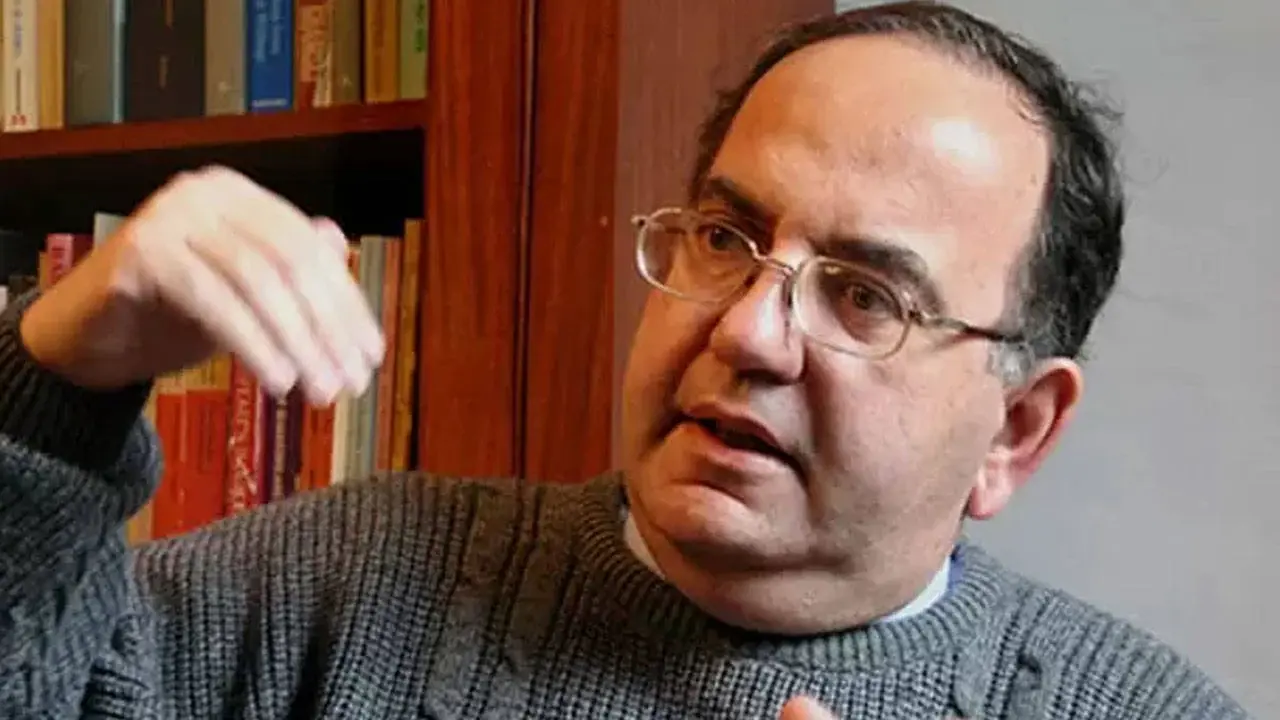
Uğur Karslı Prof. Dr. Peter Mayo, who participated as a guest at the 6th Democratic Education Congress organized by Eğitim Sen last month, emphasized that “we need critical consciousness more than ever,” concluding his...
Uğur Karslı Prof. Dr. Peter Mayo, who participated as a guest at the 6th Democratic Education Congress organized by Eğitim Sen last month, emphasized that “we need critical consciousness more than ever,” concluding his remarks by saying, “While moving within the framework, think outside the box of the framework.
(In this way) we think of a different world which we can collectively create”. Mayo, an education sociologist whose many books have been translated into our language, answered our questions on topics ranging from the philosophy of education to politics in light of his inspiring speech given at the congress. As you concluded your speech at the Democratic Education held in Ankara in August, you referred to the metaphor of “the serpent beneath the innocent flowers” from Shakespeare’s Macbeth. Throughout much of your speech, you emphasized that the shift from UNESCO’s concept of “Lifelong Education” to the EU’s concept of “Lifelong Learning” was not innocent at all.
We would like you to elaborate a bit on the “serpents” underlying this conceptual shift. Yes the discourse is deceptively disarming as it echoes the old ‘ inspiring’ UNESCO driven concept of Lifelong Education, a term said to be coined earlier by Basil Yeaxlee. It has this ‘ innocence’ about it but it is very insidious.
it sounds like the earlier concept but is so markedly different. The old concept underlined education in its broadest forms…building schools, universities, community places, utilising different spaces for education in its broadest contexts especially nonformal popular education. It highlighted communities, the collective and ownership with societies as ‘big’ learning centres…the learning society.
The later all pervasive discourse is insidious as it is individualistic, ‘employability’ and that one invests in one's own learning irrespective of one's means. It is all about individual responsibility and not collective and social responsibility. Responsibilisation is the critical Sociological term used to expose it.
It is all about choice and consumption in a market jungle. If you fail it is your fault. It places less onus on a social state and more on the individual.
The older discourse it deceptively echoes placed emphasis on education even when speaking of a learning society. Education had a normative dimension, presented as something worth pursuing for the good of society at large. The later discourse represents a subtle discursive shift…I can learn anything from being a crime boss, an artful law dodger…to being a good husband or teacher, etc…anything.
More than this, at the heart of Lifelong Learning lies the Neoliberal ideology. You learn to pull up your bootstraps or else be a ‘ dead duck’. If its the latter, as a result of your social location in a structurally discriminating world, no mechanism is there to pull you up.
Hence this sits well with the loss of the Social/ Welfare state and its replacement by a Neoliberal one. It smacks of Margaret Thatcher insistence that there is no such thing as society, implying there are only individuals acting out of self interest - a Darwinian world. This is why the lifelong learning discourse can be so insidious, the serpent lurking behind or beneath the innocent flower, to borrow Shakespeare's metaphor expressed by Lady Macbeth.
We know that, apart from the two instances when the U.S. withdrew from UNESCO—both of which occurred during the Trump administration— the States also withdrew in 1984. From your speech at the 6th DEK, we understand that during the era of the bipolar world, there was a struggle for hegemony played out through UNESCO. As a scholar who also conducts research within the framework of UNESCO, could you tell us a bit about the course of this “struggle for position”?
I need to stress that though I have,written a lot about Lifelong Education/Learning, influenced in my early forrays into this,area by my former teacher, at undergraduate level, friend and colleague, Kenneth Wain, I do not claim to carry out research in the framework of UNESCO. Yes I have published three times in its journal International Review of Education, on whose Editorial Advisory Board I serve and have attended two conferences in all but this is as far as my connection with UNESCO goes. It is more accurate to say my policy fidelity document critique of the later Lifelong Learning discourse, a hegemonic discourse, focuses more on the European Union, rather than UNESCO.
That provides the context for my frequent critiques. As for the main thrust of your question well the earlier period 1984 coincided with the time when a great prize for literacy was awarded. This was the Nadezdha Krupskaya Lenin prize.
She was heavily involved in the coordination of the Russian mass literacy campaign; she was deputy Education Commissar 1929-1939. This was considered a top UNESCO Prize for literacy. This was naturally sponsored by the Soviet Union.
It was won by countries and regions that made giant literacy strides, including, in Nicaragua’s case, the celebrated Cruzada de Alfabeticación following the 1979 Sandinista Revolution. Regions and organisations in Tanzania, China and Cuba as well as mass national literacy campaigns in countries such as Vietnam and Angola won the prize. Once the USSR was dismantled, this prize stopped being awarded.
Furthermore, there was a Left wing slant to such UNESCO concepts as Lifelong Education during that period with writers such as Bogdan Suchodolski, the Marxist-Existentialist Paul Lengrand and radical left wing thinker, Ettore Gelpi featuring prominently. This movement petered out round about the time, or possibly slightly earlier, of the fall of the Berlin Wall. Of course there are scholars such as Maren Effert who have carried out more work on this than I have.
She would be in a better position to answer this question to your satisfaction. What you said about education as a civic right being reduced to employability reminded me of the MESEMs in Turkey. It’s a vocational training model where children spend one day at school and four days at a workplace, with their wages covered by the government in the form of incentives—a model that occasionally makes headlines due to workplace fatalities.
Is the transformation of young people into cheap labor for capital under the guise of employability a global phenomenon? Well yes. It somehow reminds me of Malta's University Worker-Student scheme from 1978-1987 when certain sectors such as schools depended on a constant supply of students working for five and a half months and paid at a rate below that of a fully fledged professional teachers.
It has to be said however that students were paid this salary all the year round, even during their five and a half month study phase and their August vacation month. So it evened out. The problem though was that, in the case of teachers, students who were not yet fully fledged professionals were placed in total control of a child's education for half a year alternating in the second half with another student who was, in the previous five and a half months, on the study phase.
During those ten years of this scheme’s operation, brought to an end by a change of government, the eventual graduates,were employed on graduation, mainly in the public sector. So it was,not solely about employability but also employment. However there is a case to be made in at least many sectors such as apprenticeship schemes that while gaining experience, trainees can serve as cheap labour.
In the Malta 70s-80s case, the apparent cheap labour was offset by sums spent on supporting students during their studies. It was in many respects ostensibly a socialist measure to prevent working class kids from being a burden on their parents. While for many this proved to be the case and I was one of them, having lost my father, a salaried employee, when I was just 16, with there being no other family bread winner, this could not have been the case with the bulk of students.
Sociological research has for donkey’s years underlined the strong correlation between socio-economic family status, namely social class, and educational success. A reform at University level might be too late unless backed by a thorough restructuring in prior educational provision. In terms of class representation, the game might well be truly over by the time we get to university.
The social selection will have occurred much earlier. As for ‘employability’, the current mantra, this can be deceptive. It does not necessarily mean actual employment and at the anticipated level.
It can be a ruse to conceal a jobs crisis appearing ideologically as a skills crisis. I am using ‘ideology’ here as mystification, an upside down version of realiity through what Marx and Engels call ‘ a camera obscura’. Rather than tackling, head on, Capitalism and its inability to generate jobs as a result of its inherent crises cycles, we place the onus on individuals not having the skills - always blaming the victim Here in Turkey we consider MESEMs as 'child labor' and "cheap labor for the capital" under the guise of vocational training.
That's why we protest this model. But I have been wondering your attitude towards vocational training in practice. How should it be?
Where should it be? My position on Vocational Training is that trainees should be adequately paid for any work carried out at a rate established in agreement with the genuine representative union for that sector and that the programme extends beyond simple skills transmission to involve a broader education. This would involve not simply education FOR the economy but also CRITICAL ENGAGEMENT WITH the economy. It should be concerned with not simply 'employability' but ACTUAL EMPLOYMENT.
Unions should protect trainees as potential future full members to make sure they are not exploited or used as 'scabs'/strike breakers during industrial disputes. In your book “Gramsci, Freire, and Adult Education”, you discuss Gramsci’s assessment of “capitalism’s need to periodically reorganize itself” as presented in his essay titled “Pro-Americanism and Fordism.” Can we evaluate neo-fascist leaders—who view democracy as a hindrance—as the “New Caesars” (to use the term from your 6th DEK speech) in the context of this need of capitalism? Well yes in terms of exerting executive powers to shape Capitalism in a certain direction and in a most authoritarian, despotic manner.
Democratic deliberation would be considered a hindrance andmso Caesarist authoritarianism works with a combination of right wing populism to generate fear and proving to be the strong person to allay them and trampling over democratic rights. It is as though fascists like Trump are hollering “ I can sort this mess [created by those branded traitors or invadors - made scapegoats], as long that you acquiesce while I do away with all this jazz regarding rights [ read: trampling on civil liberties]...these people who keep pussy footing, claiming civil/ democratic this and that are the real enemies, your enemies…they take your jobs, they pose dangers to your neighbourhood…” And yet Capitalism needs these workers from beyond the country’s borders “ as long as they do not enjoy citizenship rights do the job, are paid a pittance, when services are no longer required, pack up and leave.” The situation was captured a long time ago by Wooody Guthrie in his folk song ‘Deportee’ or ‘Plane Crash at Los Gatos’. In your speech, you emphasized the importance of ordinary people having a say over their own lives.
Throughout history, working-class communities have set examples of this. In Turkey, in addition to self-management practices such as Yeni Çeltek and TARİŞ, the Gezi Forums also embody this spirit. In one of your works, you also mention the Drydock example from Malta. Could you tell us a little about that experience?
The Malta Drydocks experience was a project of self-management. Running at a loss it was handed over to workers by a government invoking Socialism. This was the time when Malta had Dom Mintoff as Prime Minister, a declared socialist, committed to Non-alignment and who, more than once, hosted Field Marshall Josip Broz Tito when Yugoslavia was an important Mediterranean nation.
It is fair to assume that Tito's Yugolavia exerted an influence over Malta especially in the sector of self-management. The Drydocks was not the only site where self-management was introduced. Other firms where this experiment occurred where Melita Knitwear and Cargo and Handling. The whole process was the subject of a study by Gèrard Kester, a Dutch PhD researcher at the Institute of Social Studies in The Hague.
His study resulted in a book, Transition to Workers’Self-Management. Its Dynamics in the Decolonizing Economy of Malta. The book advocated the setting up of an agency at the University of Malta to monitor, via research, the experiments taking place and also educate people in the task of self-management.
It also promoted research on and prepare people to manage cooperatives. This idea echoed education initiatives in Yugoslavia with its plethora of people's universities in the country's non-alligned economy. I partly connected with this agency occasionally guest lecturing in its Diploma in Labour Studies in the 1990s, carrying out research for a chapter in my first PhD thesis and having served, for many years, on its Board.The Centre was originally known as the Workers Participation Development Centre, very much in the spirit of the Self-Management model, Cooperatives and the presence of worker directors on publicly owned company boards.
The 1987 change of government from Socialist to Christian and the onset of Neoliberalism coincided with a dwindling of self-management culminating in calls for restructuring at the Malta Drydocks, ironically during a two year Labour Government interlude, but a Labour Party then being markedly different from when under Mintoff. Eventually after the Nationalist Party was returned to power, following a snap election in 1998, employment at the Malta Drydocks dwindled considerably, culminating several years later in its being privatised. This brought an end to an axample Self management experiment on a relatively grand scale - that at the Malta Drydocks.
The WPDC changed its name after 2000 to its current Centre for Labour Studies which sounds great though its main evening honours degree course is in Human Resources and Work. I personally never liked the HR dimension, an area which served companies as a ploy to coopt people from unions with lucrative jobs to serve as HR Managers. It is often argued that without the HR carrot, the centre would not attract enough students.
I find this problematic and I suppose one can here take comfort from Karl Marx statement, in the 18th Brumaire of Louis Napoleon, that people can bring about change but not under conditions of their choosing. This calls for a dialectical approach vis a vis the current existential forces. The question remains: who coopts whom under this arrangement?
How is the hegemonic management-driven mantra of HR dialectically engaged with? I would like to think that the jury is still out on this though I remain unconvinced. It is easy to lapse into the Freudian defence mechanism of rationalisation in these circumstances.
Your research on education is taking place at the intersection of the ideas of Antonio Gramsci and Paulo Freire. You view the relationship between the two as one of “complementarity.” I’d like to ask you to discuss the key points that led you to this perspective. To synthesise this in a short answer is a tall order.
They both make praxis their central concept, Gramsci renders it the focal point of his7 over arching philosophy and Freire does likewise with his much loaded pedagogical approach and politics. Both engage dialectically with what is to explore possibilities for what can be. Dialectics are the main feature of the writing/thinking style in Paulo Freire's magnus opus, Pedagogyof the Oppressed, especially the first three chapters.
Both engage ta ‘tactically in’ and dialectically ‘with’ the system while being ‘ stratigically outside’ acting tactically while being guided by a vision that transcends the system, the ever so current imperial, globalising system. Both view education in its broadest dimensions and lying at the heart of all forms of power, both to cement the existing power structure and most importantly to challenge and change it. Both see most power structures as being relational and hence the challenge is to collectively renegotiate these relations, be they the one-time factories of ...
the state which is not a thing but partly an ensemble of legitimised/ legitimising relations and we can go on and on. Both see education as a way of life and society as one large school/ learning at the heart of hegemony whose seeds of change lie within its own interstices. While never eschewing political economy, both attach great importance to the cultural bases of social change.
Culture is not a set of epiphenomena but lies at the kernel of the Base-Superstructure metaphor. Every struggle for social transformation has its strong cultural/ educational/ learning dimensions. In your latest book, you have examined the southern Europe and beyond in the Mediterannean.
To speak with Gramscian metaphor, where do the arms of 'the octopus' extend in the Mediterannean? Would Gramsci have a say about Palestinian issue? The arms of the octopus reached from Europe and especially Britain to the heart of Palestine to establish a satellite 'Western' colonial state in the midst of Arab countries in the Mediterranean. The idea was to have a 'Western' colonial outpost, of settler European Jews, removed from Europe with the outpost armed to its,teeth, to extinguish any threat of Arab insurgency in and throughout the region.
I do not know what Gramsci would have said but I suppose he would have been tempted to extend the octopus metaphor to this part of the world the British called the 'Middle East' in relation to the one time centre of colonial power that was London, as Nawal El Saadawi astute remarked. A bloc in that area was created as a force subservient to 'Western' capital, just like the Agrarian bloc in Italy's 'South' was to ' Northern' capital.Palestinians, the inhabitants of the land were the remaining stumbling block that stood in the way They therefore had to be erased by a clear form of settler colonialism and ethnic cleansing with their land declared terra nullius. I discussed Gramsci's relevance to this situation in a paper published in Journal of Holy Land and Palestine Studies subsequently reproduced and updated in the book to which you referred: 'Southern ' Europe and Beyond in the Mediterranean. Critical Essays on Adult Learning and Education, published in 2026 by Brill. May it find many readers.
We look forward to reading the book in Turkish soon. Having referred to Gramsci much throughout the interview, we sincerely greet you with "pessimism of the optimism of the will"... Hope to see you again on better days ahead.