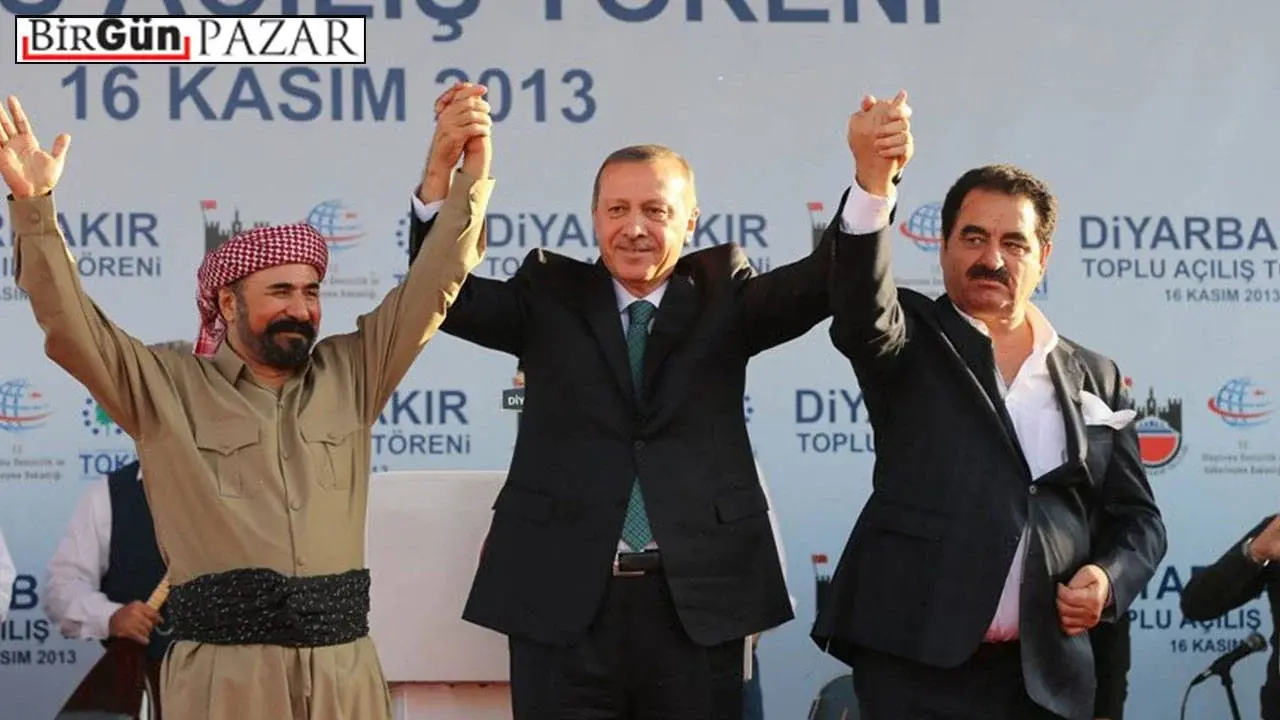
This week, for our readers, we are reminding once again of the AKP's first process opening, how the government instrumentalised the Kurdish issue for its own interests, the crises, destruction, and fractures experienced in this period, and how it concluded. FROM DIYARBAKIR TO THE EU The negotiations within the scope of Turkey’s accession process to the EU date back to the pre-AKP era. The DSP-MHP-ANAP coalition government had begun to take a series of structural harmonisation steps to pave the way for full membership negotiations with the EU.
The steps taken, including the abolition of the death penalty, had also begun to form a significant foundation regarding the Kurdish issue. The words of Mesut Yılmaz, one of the coalition partners at the time, stating that "the path to the EU passes through Diyarbakır," were also spoken as an eloquent expression of this policy. Following the end of the government, on which Bahçeli pulled the plug, negotiations with the EU were continued with the AKP, which had come to power.
For the AKP, which rejected the anti-Western character of the Milli Görüş line by saying "we have changed our shirt," the support of the US and the EU would be the most important force that also opened the doors to power. This period, when Erdoğan was not yet firmly seated in the seat of power, would be experienced as an interim period where conflicts within the state were decisive. While the EU lever was kept as the most important link in the illusion of democratisation, moderate messages regarding the resolution of the Kurdish issue within the scope of full membership with the EU continued to be given constantly.
In the conflict extending to the 27 April e-memorandum and closure cases, as the AKP tried to take steps to broaden its own front, one of the most important of these was keeping an atmosphere of solution-optimism regarding the Kurdish issue alive. In 2005, the Prime Minister of the time, Erdoğan, would say in his speech in Diyarbakır, "To those who ask what will happen to the Kurdish issue, I say that as the leader of this country, that issue is my issue before anyone else's. (...) We will solve every issue within the constitutional order with more democracy, more citizenship law, and more prosperity." Within this created atmosphere of optimism, democratisation and the expectation of a solution in the Kurdish issue as a part of it, served as a source for direct or indirect support for the government in the process extending from the conclusion of the struggle within the state in favour of the AKP through the Ergenekon operations, to the 2010 referendum.
During the 2010 referendum process, a call for a boycott was made together with the Peace and Democracy and the socialist parties around it, and this call significantly influenced the referendum results in favour of the AKP. Even though it did not make the agenda as much as "Not Enough but Yes," the BDP's boycott decision actually turned into the greatest support the AKP received in this process, becoming effective enough to change the outcome of the referendum. This process would be explained as support given by Öcalan for the "AKP to fully settle and mature" within the scope of the politics maintained since 2002.
The call of the Boycott Front of the Labourers and the Oppressed, established by the BDP and its supporting socialist parties, found a significant response in the Kurdish provinces; in some provinces where voter turnout did not even reach 10 per cent, there were virtually no 'No' votes in the ballot boxes. THE "YES BARGAIN" Prior to the referendum, BDP Co-Chair Demirtaş stated that they could change their Boycott stance to Yes, and for this, he made various demands from the ruling AKP: "If Erdoğan lowers the electoral threshold to 5 per cent, if our imprisoned friends are released, and if he says in this square that he will solve the Kurdish issue in a new Constitution, we will discuss this with you. Other than this, there is absolutely no going to the ballot box." Demirtaş would celebrate the referendum results by saying, "We continue the struggle until we crown this success with democratic autonomy." Ertuğrul Kürkçü, one of the supporters of the Boycott front, was also among those who saw the referendum results as glad tidings in the process of democratic autonomy.
He had interpreted the results as the AKP being cornered by the forces of freedom. Ultimately, thanks to the boycott organised by the BDP in the Kurdish provinces, the AKP won the referendum by a wide margin. Following the referendum in Diyarbakır, anthems were played and fireworks displays were held at the BDP provincial headquarters.
BDP Co-Chair Selahattin Demirtaş said, "I congratulate our people. We say continue the struggle until we crown this success with democratic autonomy." STEP BY STEP TOWARDS A NEW WAR The 2009 Oslo talks between the Kurdistan Workers' and the National Intelligence , which the public would later become aware of through a leak aimed at sabotaging the opening process, were an expression of a search for a solution. This process, progressing intermittently, was taken to a new stage in December 2012 with the announcement by the Prime Minister of the time, Erdoğan, that talks were being conducted with Abdullah Öcalan in İmralı for the resolution of the Kurdish issue.
As a result of the negotiations conducted, the process advanced in April 2013 with the PKK beginning to withdraw its armed forces in Turkey upon the call of A. Öcalan. Within this process, where a large part of the democratic and left-wing public supported all steps taken towards achieving peace and meeting the demands of the Kurdish people, undoubtedly, the AKP continued to pursue its own narrow interests once again.
The AKP, which was in search of consolidating its own rule, including the transition to a presidential system, wanted to turn the internal peace process into an opportunity for its quest to become a power, tied to American policies in the Middle East, especially with the Syrian civil war. In the Middle East, Kurdish dynamics were seen as one of the important connections of the project for a political Islamist ruling belt tied to American policies. New National debates, expanded around a Kurdish-Turkish alliance extending to the Middle East through the internal peace process, were also finding a place in the negotiation process texts.
While the AKP tried to fortify its rule domestically and simultaneously pursue a neo-Ottomanist expansionist policy in the region, this process was fractured in Syria. Under the conditions where the alliance the AKP tried to establish between the Free Syrian alongside other jihadist gangs it supported, and the Democratic Union did not materialise, the negotiation table also began to fall apart. One of the most important breaking points occurred after the ISIS barbarism laid siege to Kobanê in October 2014; following the tension raised by Erdoğan's words "Kobanê is about to fall," the events of 6-7 October took place, which turned into clashes in many provinces.
The Kobanê events, in which many Peoples' Democratic executives, along with the HDP Co-Chairs, were tried and sentenced, went down in history as a significant breaking point. Leading up to the 7 June elections, coupled with thoughts that this process was also causing the AKP to lose votes internally, Erdoğan ignored the Dolmabahçe Agreement signed before the election and started a new process. This path entered for a solution eventually evolved towards a massive war spreading to the whole country with the clashes that began in the period leading up to the 1 November 2015 elections and the bombs detonated thereafter.
THE ERDOĞAN-BAHÇELİ ALLIANCE AND THE CONCEPT OF WAR INSIDE AND OUTSIDE The Erdoğan-Bahçeli alliance began to be established in 2015 during the period leading up to the 1 November elections. The most important mortar of this alliance was the Kurdish movement, receiving support from the US, beginning to form an autonomous sphere of power in Syria. The war that began with declarations of autonomy between the two elections and deepened internally took place, in a sense, as an extension of the front in Syria.
The conflict that deepened in the Kurdish provinces between 7 June and 1 November turned into a fracture that would change the destiny of the country. By overturning the table at Dolmabahçe and declaring total war, the AKP took back the votes it had lost to the MHP on 7 June, on 1 November. In the subsequent process, by declaring the MHP the junior partner of the government, it determined a new political line feeding on ethnic-based conflict.
• Cross-border operations and the redesign of politics On the other hand, the fracture that began in Syria continued to deepen across the Euphrates. The cross-border operations initiated by the AKP in Afrin and Idlib, aimed at both dividing the Rojava cantons and cementing the fragmentation of the country by settling the opposition forces they supported deep within Syria, were also carried out with the support of an opposition aligned behind national security propaganda. The bill for these military adventures, which replaced the AKP's strategy of "religious brotherhood," was once again made to be paid by the public.
While on the one hand the integrity of Syria was being dynamited, on the other hand, mortar was added to the antagonising climate in the country, and the cost of these operations triggered the economic crisis that began in 2016. The new strategy built upon the conflict strategy that began between the two elections, also fed by suicide bomb attacks internally, brought with it a new wave of hatred centred on the HDP nationwide. Between 2015 and 2016, dozens of HDP buildings were attacked, set on fire, and flags were hung on the buildings.
A new climate of fear and hatred was organised in society through fascist attacks organised on the streets by the government. In the attack on the HDP building in Izmir in 2021, party worker Deniz Poyraz was murdered. • The climate of conflict paved the way for the presidency Undoubtedly, this strategy bore meanings beyond merely consolidating MHP votes in the ruling front.
The purges created within the state and counter-guerrilla by the AKP-Gulenist conflict, which reached its peak especially with the coup attempt on 15 July 2016, also brought along a new cadre formation for which the MHP would assume political representation. In addition, through the climate of war and terror created, it also aimed to break and divide the new wave of social opposition, which reached its zenith with Gezi in 2013, through policies of repression and antagonisation. The new war aimed to suppress the opposition not only on the streets but also in parliament.
A process in which the parliament was gradually deactivated began with the vote on immunities. Following the decision to lift immunities, to which the CHP said "Yes knowing it is unconstitutional" for a reason that is still not fully understood today, it became easier for the government to intervene in the parliamentary arithmetic through the judiciary it seized. In 2016, the immunities of 15 HDP MPs, including Selahattin Demirtaş and Figen Yüksekdağ, were lifted, and they were imprisoned.
The HDP politicians who are still kept inside today despite the Constitutional Court rulings have turned into one of the political victories most highlighted by the AKP's new alliance. Likewise, the conditions that brought about the regime change achieved through the State of Emergency, which started after 15 July and was maintained for 2 years, and the dubious referendum held under these conditions, developed within the climate of war that began in the summer of 2015. The climate of fear, produced by dozens of Kurdistan Freedom and ISIS attacks that suddenly stopped when OHAL began, created a process where social opposition was suppressed while the destiny of the country was altered by Statutory and the Supreme Election Council coup.
• The coup plotter left, the terrorist arrived The political language uniting the representatives of the People's Alliance, which was formed with the overturning of the table after 7 June, fed off this conflictual climate and transformed into a form that attempted to criminalise and suppress all kinds of opposition. The entire political strategy of Erdoğan and his associates, who never dropped the words peace and brotherhood from their mouths until 2015, turned into accusing and suppressing all opposition with the label of terrorist. This inflation of the term terrorist, which replaced the coup plotter label in the language of government representatives with the same shallowness, essentially narrowed the political space progressively, creating a strategy of fashioning an acceptable opposition within the boundaries drawn by the AKP.
This strategy, which succeeded by dragging the main opposition behind the government on critical agendas such as cross-border operations and immunity voting, in one aspect created a climate where the streets were turned into bogeymen by all parliamentary parties. At the point reached by the terror propaganda, where the AKP-MHP alliance prevented the opposition from developing a serious objection due to acceptable politics concerns, it culminated in Erdoğan using montage videos showing Kılıçdaroğlu in a PKK camp during rallies in the 2023 elections. The strategy, cemented by the one-man regime and terrorising all dissenting voices, encircled all politics around a question of survival.
With the strategy initiated in 2015, the AKP not only aspired to nationalist votes but also created a serious voting power for nationalism by conferring prestige upon this marginal politics of the past through the hands of the government. In this way, it nourished popular nationalism in the country again, gaining a new room for manoeuvre for the government. This space won Erdoğan new and loyal political actors and Trojan horses.
So much so that after the MHP formed an alliance with the AKP, the dissident nationalist wing gained strength under the influence of the nationalist backlash created in the country and took the opposition front under its influence as well. The İYİ Party became the second largest party of the opposition wing; thanks to this position, it was able to execute its "Making the man win" strategy in the 2023 elections and broke up the opposition alliance two months before the elections. On the other hand, the Zafer Party became the party that took the most votes away from the opposition bloc in those elections, and the presidential candidate it put forward declared support for Erdoğan in the second round.
TOWARDS THE NEW PROCESS: IT ALL STARTED WITH ISRAEL The US and Israel evaluated Hamas's attack on Israel on 7 October 2023 as an opportunity to redesign the Middle East. In this context, interventions stretching from Palestine to Lebanon, Syria, and even Iran were carried out. In addition to the genocide still ongoing in Gaza today, Hezbollah's leading cadres and symbolic figures were murdered through military interventions directed at Lebanon.
Forces supported by the Revolutionary Guards in Iraq were targeted. In Syria, with the progressively weakening presence of Russia, which was bogged down in the Ukraine quagmire, and the targeting of regional forces supporting Assad, all military pillars of the Assad regime were eliminated. In Syria, which has been regularly bombarded since the beginning of the genocide, a new era has also begun in Turkey with the overthrow of the Assad regime and Hayat Tahrir al-Sham being brought to power in December of last year.
In a regional conjuncture where the sole target is Iran, whether explicitly named or not, the repositioning of political actors in Turkey has also become a necessity. The new Middle East order initiated by Israel has turned into an opportunity for the ruling bloc both internally and externally. Israel's expansion of the war from Gaza to the entire region up to Tehran reminded Bahçeli of 'peace' (!).
In a conjuncture where the regime's economic and political crisis deepens and continues, and its crisis of governance deepens with weakening social legitimacy, the AKP-MHP duo saw this situation as an opportunity to sustain and consolidate the regime. The common and main underlying reason for the terror-free Turkey policies of Recep Tayyip Erdoğan, who received Trump's full support to protect his rule, and Devlet Bahçeli, who made a U-turn on the Kurdish Issue, is the duty they carved out for themselves in the reshaping of the Middle East. As a matter of fact, the 19 March process, one of the biggest civilian coup moves against the opposition in recent years, could come with the Middle East-focused support of the US.
While Tom Barrack, the figure at the centre of discussions today, heralded that "good news will come from Turkey" one day before 19 March, the AKP-MHP bloc did not hide at all that they were acting with Washington's support. There was only one thing requested from the ruling bloc, which is ready to dynamite the entire region to get Trump's 'well done': "Not to be foolish" and not to stand against Netanyahu. As a matter of fact, the government, which has given Israel all kinds of economic and logistical support since 7 October, is now in a race to fragment Syria, where they changed the regime in cooperation with Israel.
Therefore, the influence to be established in Damascus and Rojava has been of vital importance for the AKP-MHP bloc since Israel's first bombardments in Syria. The government knows that its room for manoeuvre in Syria is not what it used to be, with an Israel increasing both its military and political presence by exploiting religious conflicts in the south of the country. This is one of the most important reasons why this “terror-free Turkey” process is being carried out so hastily domestically.
"IN ORDER TO GET ERDOĞAN ELECTED ONCE AGAIN" From the very beginning of the process, it has been voiced by the government partners at every opportunity that the issue is not a democratic and peaceful solution, but keeping the regime standing and a lifetime presidency. The process, which started with shaking hands with the Peoples' Equality and Democracy group on 1 October, advanced with Bahçeli's statement on 22 October, "Let Abdullah Öcalan come, speak at the DEM group, and let this process end." Erdoğan's silence to Bahçeli's words in those days caused evaluations of "Is there a rift between them?". On 30 October, Erdoğan gave his full support to Bahçeli.
Erdoğan, who described the issue as eliminating the terror problem, approached it through internal fortification and the danger of Israel, whilst also underlining his aspiration for a lifetime presidency; he made the statement, "Bahçeli showed that he is a true nationalist. We will crown our 40 years of political life by eliminating this issue." To criticisms regarding whether the process was being conducted to extend Erdoğan's presidential lifespan, Bahçeli gave an answer emphasising that it indeed was. At the group meeting on 5 November, Bahçeli spoke as follows: "If a severe blow is dealt to the inflation monster, if Turkey rises to the peak of political and economic stability, isn't the re-election of our President Mr Recep Tayyip Erdoğan a natural and correct choice?
What are we going to do, look for a candidate within the CHP with four years to go?" "Within this scope, will it not be among our duties ahead to make the necessary constitutional arrangements? For continuity in the state, stability in politics, and the construction of the Century of Turkey, Mr Recep Tayyip Erdoğan is the guarantee, he is the lover of the nation, and with his experience and background, he is the only option in our view." PEACE IN ONE HAND, COUP IN THE OTHER Shortly after the start of the process, trustee politics came into play. The new resolution process initiated by the MHP brought along various trustees and operations against CHP and HDP municipalities.
First, days after Bahçeli's first speech on the resolution process, Esenyurt Mayor Ahmet Özer was arrested on terrorism charges generated through a CHP and HDP electoral consensus, and a trustee was appointed in his place. This process was followed by trustees appointed to the Batman, Mardin, and Halfeti municipalities on 4 November. During this process, trustees were appointed to a total of 11 municipalities from the CHP and HDP.
This was followed by operations against CHP municipalities after 19 March. However, the biggest attacks against the opposition started with the 19 March process. The targeting of over 80 CHP figures, primarily the opposition's presidential candidate, Istanbul Metropolitan Municipality Mayor Ekrem İmamoğlu, with terrorism and corruption accusations opened a new and dark era in politics.
The 19 March process transformed into the anger on the streets of millions in the country, especially university students, who want to get rid of this system and government. Mass protests took place across 71 cities of the country for days, surpassing even the CHP, the main interlocutor of the process. However, 19 March also became the premature end of a process conducted with diplomacy and 'courtesy' among the AKP-MHP-DEM.
It demonstrated that the ruling bloc could not secure its own future merely through constitutional possibilities and a new candidacy to be presented to Erdoğan. In this process, which still continues today with arrests and detentions, images of police violence attempting on the lives of 18-19-year-old students in city squares in the evenings have been included amidst parliamentary speeches concluded with hand-kissing and praises. Once again, it was the people on the streets who demonstrated that for the people of Turkey, salvation from the current government is the only issue.
In this process, neither Bahçeli, who was given unearned democratic titles out of thin air, nor the Dem Party, the interlocutor of the process, took a clear stance. The narrative of 'the democrat Bahçeli against the statist Erdoğan' told in liberal publishing organs could not turn into anything more than a baseless delusion in a period when the right to elect and be elected in the country was de facto confiscated and thousands of young people were repressed with violence and detentions. Likewise, Erdoğan and Bahçeli never mentioned a democratic solution in any of their discourses and actions throughout the process.
The process was described through the rhetoric of a terror-free Turkey and Kurdish-Turkish brotherhood. In fact, when the time came, signs that the process could continue with oppression and the stick were given many times. Erdoğan stated that he would not hesitate to put the iron fist inside the velvet glove into action when necessary.
Although the DEM and İmralı delegation raised their voices against trustee politics and anti-democratic practices, they displayed an attitude aimed at not entangling this politics with the process. Sırrı Süreyya Önder from the İmralı Delegation made statements supporting this situation with similar rhetoric; "In the public eye, the concepts of solution and peace are frequently confused with each other. This is not correct.
Peace is something that can be established even with a hug. A solution is a democratic struggle and a long-term undertaking." THE 'PEACE OF THE UMMAH' In the process initiated and occasionally accelerated by the transformation in Syria, Syria and even Iraq in some instances were abundantly included in the agenda within the topics claimed to be regarding the peace of the peoples of Turkey. Turkish-Kurdish peace was frequently described like a 'peace of the ummah' in harmony with the relations intended to be established between Damascus, captured by the jihadist HTS in Syria, and Rojava.
Speaker of the Grand National Assembly of Numan Kurtulmuş created controversy with his words at the Şırnak Civil Society Meeting held at Şırnak University on 19 March 2025; "...Another alliance is the great alliance made by Yavuz Sultan Selim and Idris-i Bitlisi against Shah Ismail, who made the lands of Anatolia groan with cruelty from top to bottom. That alliance we had in Çaldıran in 1514 ensured that the Muslim communities in Anatolia walk with their heads held higher, and exist together in peace and unity." Kurtulmuş's example of Idris-i Bitlisi and Yavuz Selim symbolises a Sunni alliance against Alevi and Shiite peoples in the region. Likewise, while one of the very first acts of the HTS, which receives support from Ankara, after the fall of the Assad regime in Syria was the ongoing massacres against Alevis in the country, one of the main motivations of the Islamist government for a Syria-focused process emerged with these words.
However, Kurtulmuş was not the only one who saw peace among the ummah of a sect rather than peoples. In his speech on the anniversary of Malazgirt, Erdoğan proved once again that the cooperation and unification desired with the process is limited to neither Turkey nor the peoples of Turkey, with his words; "Malazgirt is the common victory of the Turk, Kurd, and Arab. Çaldıran is the common victory of the Turk, Kurd, and Arab.
Ridaniya, the conquest of Jerusalem, the conquest of Istanbul are our common victories." Making a similar statement in August 2025, Erdoğan underlined the historical cooperation of the Turk, Kurd, and Arab. These words uttered for the first time by Kurtulmuş and Erdoğan, based on both ummahism and a sectarian influence beyond the borders of Turkey, need to be read together with larger-scale claims regarding the future of the region. As a matter of fact, Tom Barrack pointed out that countries possessing stability, peace, and sovereignty in the region, actually including Turkey, are threats, with his words in a speech he gave last month, "Strong nation-states are a threat.
Especially Arab states are seen as a threat to Israel." Indeed, following Bahçeli's "Kurdish and Alevi vice presidents" remark, which served as an assist to Barrack, Lebanon and Iraq models were opened up for discussion for both Syria and Turkey. However, these models were brought to the agenda not with the goal of democratisation and peace, but ultimately so as not to pose a threat to Israel and American interests in the region, as in Barrack's words. At the point reached today, all criticisms regarding the current framework law and the process made in the name of democracy and peace, questions of how both a coup and democracy will be possible at the same time, are mostly answered with warnings that Turkey is on the brink of a new international conjuncture and that the approach to the Kurdish issue must be understood in this context.
It is proven every day with a different development that the regional threat pointed out by the government wing as Israel is actually Iran, and that 'gaining more influence in the region' means becoming more engaged in the dirty work of the US around the NATO 3.0 concept. At the end of the day, we are at the dawn of a new era where more Turkish and Kurdish children will be thrown into the fire for American interests in the region just so the government can secure the legitimacy from Washington that it cannot find in the people. Not a single democratic right the Kurdish people can win at the table, nor the silencing of weapons, are issues that can be objected to or postponed.
The main issue lies in being able to come together side by side to create a united struggle to stop the one-man regime before throwing the country further into the fire. Note: This article is translated from the original article titled Hatırlatmalar, published in BirGün newspaper on August 16, 2026.