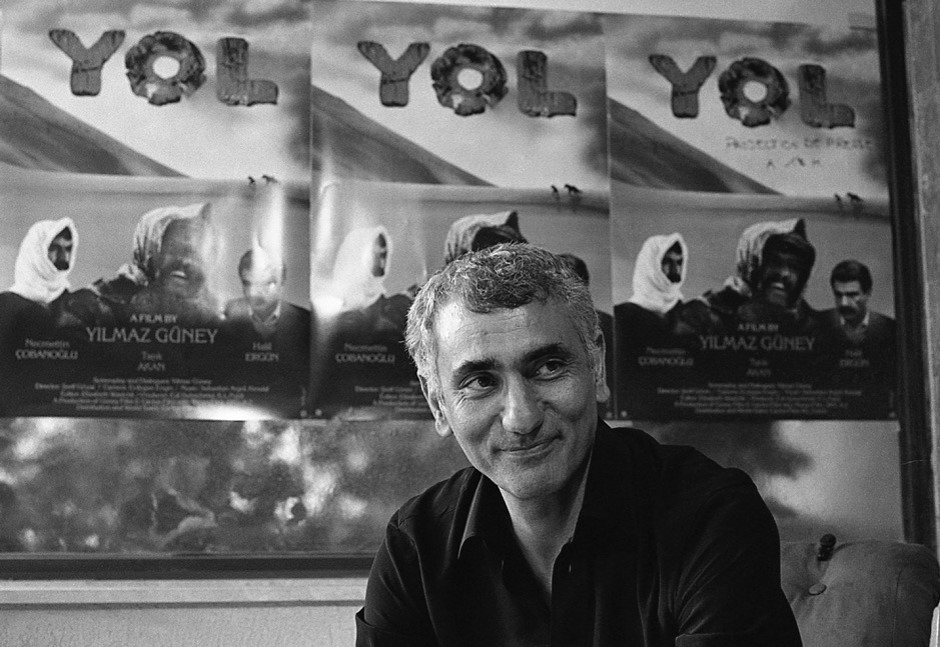
Looking back at Yılmaz Güney 42 years later: I admire his smile
If he were alive, he would be 89 today. Who knows how many more stories would have emerged from his pen, how many more films from his camera, how many more unforgettable characters through his acting; what injustices...
If he were alive, he would be 89 today. Who knows how many more stories would have emerged from his pen, how many more films from his camera, how many more unforgettable characters through his acting; what injustices and social problems he would have confronted, what wounds he would have shed light on? Photograph: Tahir Yüksel archive But I am sure he would still have been smiling beautifully… Losing Yılmaz Güney at such a young age, 42 years ago today, made me reconsider not only his legendary filmography but also his image.
I reread interviews he had given and things that had been written about him. In the process, I discovered things I had not known before. After a great deal of searching, I brought some, though not all, of his books out of the corners where they had been kept; I leafed through them and read certain sections.
I watched , , Acı (Pain), Ağı, Arkadaş (Friend), Sürü (The Herd), and Yol (The Road) again. Along the way, I made two new friends: Şûle Demirezen and Tahir Yüksel. Over the next two weeks, this column will feature interviews with them about Yılmaz Güney.
O ZAHIT, DO NOT CONDEMN US Yılmaz Güney’s films have left a deep impression on me. Every film I have watched has its own memory attached to it. I still haven't forgotten how the music that begins with the opening credits in Ağıt (Elegy) sent shivers down my spine when, in the scene where Çobanoğis wounded and the village doctor is trying to remove the bullet in the cave, it suddenly took on words with the refrain “Zahit bizi tan .” Although I still noticed the mismatch between sound and image in the close-ups as Çobanoğlu’s comrades sang this nefes, the excitement I felt erased everything negative on the screen.
The nefes stayed with me as one of the film’s most striking and richly layered musical choices. Years later, I would read the story behind selection of Muhyi’s nefes in Tahir Yücel’s book Yılmaz Güney - Endişesiz bir ülke, endişesiz bir dünya için. Ahmet Soner, Güney’s assistant, recalls that during the filming of Ağıt, everyone would take turns singing a folk song at dinner.
He says that among the songs Güney sang most often were “Baba bugün hava neden bulanık?” and “Satarım bu canı da alırım seni, çıkarım dağlara da kurt yesin beni”: “I would sing from Ruhi Su: Dadaloğlu, Kul Himmet, Muhyi… really liked the nefes ‘Zahit bizi tan eyleme, hak ismin okur dilimiz’ and wanted to use it in the film. Every morning, as we went to the set by minivan, I would try to teach the song to the actors: ‘Sayılmayız parmak ile tükenmeyiz kırmak ile taşramızdan sormak ile kimse bilmez ahvalimiz…’ Only Atilla Olgaç, who was a theatre actor, managed to learn it. The other actors had no ear for it.
We used the song in the operation scene. It was one of the most powerful scenes in the film. The Censorship Board stopped the film because of this song.” What Soner described, the actors’ inability to memorize the nefes, explained the mismatch between sound and image in the scene… THE AESOPIAN LANGUAGE In an interview with Alfreda Benge published in Race & Class, Güney was asked how censorship had restricted him and how he had managed to overcome those restrictions.
He explained that he used an Aesopian language in his films: “From the first step our film-making took, our main concern was to find new forms of expression, a new language. We had to build on the fact that we had a relationship with our audience - my being a popular actor had created this link. I had to find covert ways of expressing myself, with my face, the expression in my eyes, even by missing out bits of dialogue, by leaving out words.
In short, a common language emerged between myself and my audience in a way which, even if I didn't say anything overtly, they would understand what I was getting at. This was my way of self-protection. In my films, I used the language of Aesop.
Let me give you an example of how I would communicate. In a film made after our previous fascist military take-over in 1971, this is how I tried to articulate my feelings about the oppression unleashed on our people. A blind man learns how to use a gun; he trains himself to shoot by putting lots of bells around him, and from the sound of those bells he was able to identify his target and shoot - and that's how a blind man learned to resist.
Here, my people understood, 'Yilmaz Güney tells us that all our means may be lost, all our weapons may be taken from us, but it is always possible to find new ways to resist. New solutions never run out, there must always be a way.' And the message got through. From the outside, the film is an unassuming piece of work which resembles a western.” The film Güney was referring to was Acı (Pain).
Photograph: Tahir Yüksel archive THE WRITER IN THE SHADOW OF HIS CINEMA CAREER In the story “Üç Bilinmeyenli Eşitsizlik ,” which Yılmaz Güney wrote in 1956, he was tried on charges of communist propaganda and, in 1961, sentenced to one and a half years in prison and six months in exile. Although his first book, Boynu Bükük Öldüler, won the Orhan Kemal Novel Prize in 1972, the books Güney wrote have somehow remained in the shadow of his cinema career. The works that left the deepest impression on me are the books known as the Selimiye Trilogy: Hücrem, Salpa, and Sanık.
Salpa is the most interesting and, in literary terms, the most vibrant of the three. Another is Oğluma Hikayeler (Stories for my son), which was collected as a book in 1979 after being published with illustrations by Haslet Soyöz in Güney Dergisi. The book's greatest strength is how Güney conveys his political and social outlook through small events of everyday life, without turning it into didactic discourse.
In this sense, Oğluma Hikayeler is not merely a collection of stories told to children; it is also a personal and social testimony to the kind of world a father wishes to leave to his son. Yılmaz Güney’s first story in the Oğluma Hikayeler series, “Şeftali çekirdeğine inan, kendi gücüne gü,” published in the inaugural January 1978 issue of Güney, Aylık Kültür ve Sanat. WHO SAID WHAT Among the studies about Yılmaz Güney published in Türkiye, Mehmet Ergün’s Bir Sinemacı ve Anlatıcı Olarak Yılmaz Güney (Yılmaz Güney as a Filmmaker and Storyteller) is one of the most noteworthy and comprehensive works written about him at an early stage.
The study is structured around four main axes: Yılmaz Güney’s place in the development of Turkish cinema, his understanding of art, and his identities as both filmmaker and storyteller. In this respect, Ergün’s study differs from books that approach Güney primarily through his political identity or biography. Unlike the nostalgic or legendary texts later written about Güney, Ergün’s book was a pioneering attempt to analyze his art before he became a historical figure.
Mehmet Ergün’s pioneering study, Bir sinemacı ve anlatıcı olarak Yılmaz Güney, published by Doğrultu Publishing House in 1978. Cover design and photograph of Mehmet Ergün: İsa Çelik Perhaps the words of filmmakers and critics who assessed Yılmaz Güney from outside the borders of his own country best convey his place in world cinema. Costa-Gavras, who shared the Palme d’Or at Cannes in 1982 with and the film Missing, regarded him as “the most important Turkish director,” while Richard Corliss described him directly in TIME magazine as “a world-class filmmaker.” Years later, when reviewing Cafer Penahi’s film This Is Not a Film for The Guardian, John Patterson also took Yılmaz Güney as a direct point of comparison; he described Güney as a “Turkish cinema idol and dissident director” and called Yol (The Road) a masterpiece.
Costa-Gavras, Yılmaz Güney and Vittorio Gassman at the 35th Cannes Film Festival awards ceremony, 1982 Vidyarthy Chatterjee, an award-winning veteran film critic, writer and cultural historian known for his in-depth analyses of Indian and world cinema and radical politics, wrote the following in an article marking the 50th anniversary of : “Yılmaz Güney’s extraordinary and multifaceted genius made him a figure to be reckoned with when, after a long period as Turkey’s most popular cinema hero, he moved into directing. Yet in the history of the Turkish state and society after the Second World War, Güney occupies a place far more significant than that of merely a pioneering figure in cinema. His deep sympathy for the ‘lower strata’ of society, a recurring subject in his films, combined with his fierce opposition to the symbols of state power, the army, police, judiciary and prison system, made him a true people’s hero.” David Pendleton, a leading film programmer and writer who curated the major retrospective From the Ugly King to the Poet of Despair on Yılmaz Güney for the Harvard Film Archive in 2011, describes Güney as “a master of startling imagery, vigorous storytelling and political commitment.” NEXT WEEK - “My Uncle Yılmaz Güney” with Şûle Demirezen